


Hi readers, meet Arnold Myint, a chef and restaurateur (International Market, a tribute to his mom’s original restaurant of the same name). He’s a James Beard semifinalist and self-described “Nashville native, gay and Asian. A single dad, a chef that cooks, and a cook that eats.” Check out his cookbook, Family Thai, and his substack, A Hint of Myint.
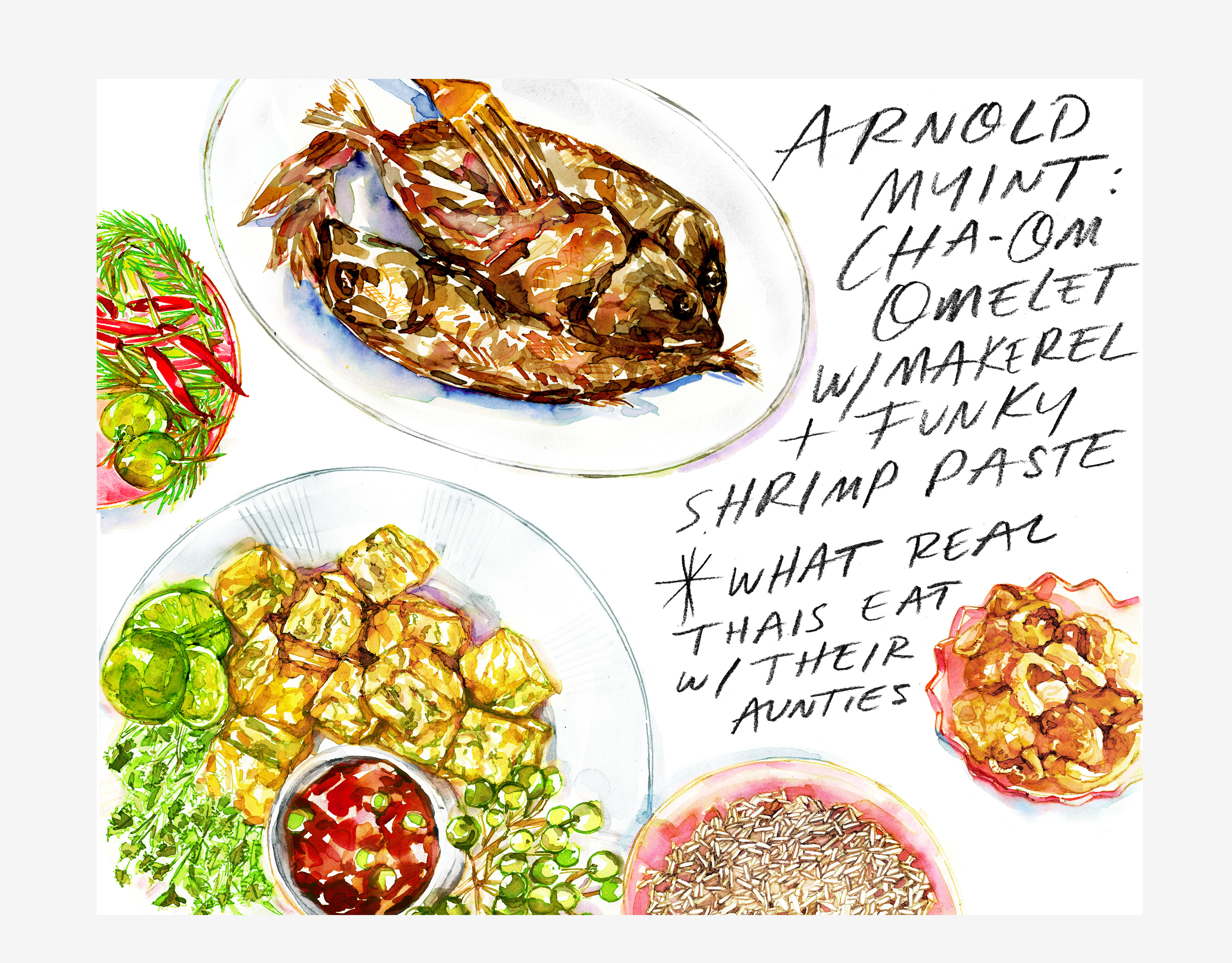
In answer to the question “What do Thais really eat at home?” Chef Myint describes the pinnacle of Thai food: Stinky Herb Omelet, Fried Cured Mackerel, and Funky Shrimp Paste Dip: Cha-Om Omelet, Mackerel, and Grapi, the perfect culmination of bitter, herbaceous, and nutty. Read on to hear how he went from hating it as a kid to loving it now. It transports him back through memories of his childhood, his mother, and his culture, especially when he sits down with the aunties to chow down. Then, try his recipe.

At my restaurant, there are a couple of Aunties in the kitchen who have been around since my family opened fifty years ago. These ladies raised me. I grew up in the kitchen, and my palate and food vocabulary evolved because of it. The restaurant’s kitchen was always my playground, but what I loved (and still love) are the daily survival kits of random Tupperware and foil-wrapped delicacies that they would bring from home to snack on throughout the day.
This dish reflects my culture and identity, rather than what I serve my Western clientele, and to me, it answers the question, “What do Thais really eat?” I can’t think of an ensemble that resembles Thai home cooking better than a bitter and aggressively funky cha-om omelet, a fried salt-cured mackerel, and shrimp paste dip to top it all off. This, alongside a steaming hot bowl of rice, is the pinnacle of Thai food. The brininess of the shrimp paste balances the pungent and nutty scent of cha-om (or acacia leaf) and is mellowed out by perfectly fried, flaky mackerel.
In full transparency, I didn’t instantly grow up loving this dish. I actually loathed it, mainly because, quite simply, the dish stinks. On one particular family vacation to Thailand, after a grueling 24-hour travel day topped with jet lag, I recall my mother’s siblings hanging out while I was trying to sleep. With my eyes shut, I tossed and turned in the bedroom next to their celebratory reunion. Whiskey and ice cubes clanked amidst boisterous conversations. Though exhausted, my senses were overcome by the funk and stench of this “very Thai” meal.
This timestamp has stuck with me into my adulthood. And now that my mother has passed, it’s become a pivotal memory. As I continue to navigate my healing, my Aunties still occasionally pull out a foil-wrapped fish and small containers of shrimp paste dip for lunch. And now, instead of tossing and turning, I pull up a stool and join them for a nostalgic taste of comfort, family, and home.
The Recipe:
Cha-Om Omelet, Mackerel, and Grapi
Stinky Herb Omelet, Fried Cured Mackerel, and Funky Shrimp Paste Dip
Makes 1 (8-inch / 20 cm) omelet; serves 4
I’ve had people ask me, “What do Thais really eat at home?” This is the answer. I can’t think of an ensemble that resembles Thai home cooking more than this bitter and aggressively funky cha-om omelet, a fried salt-cured mackerel, and shrimp paste dip to top it all off. This, alongside a steaming hot bowl of rice, is the pinnacle of Thai home cooking. The brininess of the shrimp paste balances the pungent scent of cha-om and is mellowed out by perfectly fried, flaky mackerel. It’s the most classic combination and one of my favorite meals to make and eat. In certain seasons, cha-om is available fresh in the
produce section of Asian markets. However, the vacuum-sealed frozen version still delivers on cha-om’s distinct promise and lingering attributes. Cha-om, or acacia leaves, have a one-of-a-kind smell when raw that many people find off-putting, but it is reduced by cooking. They have a flavor that many of us can’t resist—bitter, herbaceous, and nutty. Go on, give it a try!
Keep in mind that when working with this herb, there are thorns on the stems, so be cautious when removing the fronds.
For the mackerel:
About 1 cup (240 ml) neutral oil, such as sunflower, for frying
1 (9-ounce / 255 g) package steamed, cured mackerel from the Asian market (2 mackerel), defrosted
For the omelet:
4 ounces (115 g) cha-om (acacia leaves) from 1 (8-ounce / 225 g) package from the Asian market, defrosted if frozen, plus more for serving
3 large eggs
1 teaspoon fish sauce
⅛ teaspoon ground white pepper
¼ teaspoon Magic Powder (aka Asian chicken bouillon)
2 tablespoons neutral oil, such as sunflower
For serving:
Nam Prik Grapi (Shrimp Paste Chile Dip, page 74)
Steamed rice (see page 36)
Fresh cilantro sprigs
Pork rinds
Sliced cucumber
Cabbage wedges
Fresh red Thai chiles
Thai eggplants
Turkey berry eggplants
Green beans
MAKE THE MACKEREL:
Pour oil to come ½ inch (12 mm) up the sides of a large, high-sided skillet. Heat over medium-high heat until simmering. Carefully lay the mackerel down in the pan away from you to avoid any oil splashes and cook, flipping once, until the outer skin is golden, about
6 minutes. (Alternatively, you can deep-fry the mackerel.)
MAKE THE OMELET:
Carefully remove the cha-om leaves from the stems using your hands, being cautious of the small thorns. In a large bowl, combine the cha-om leaves with the eggs, fish sauce,
white pepper, and magic powder (the quantity of leaves will seem much greater than the eggs, but that is fine).
Heat the oil in an 8-inch (20 cm) nonstick skillet over medium heat. Gently pour the omelet batter into the skillet. As the eggs begin to set, use a spatula to pull the edges of the omelet toward the center and let the eggs run underneath. Continue pulling until the bottom of the eggs are set but the surface is still runny, about 2 minutes.
Carefully flip the omelet in the pan, using a spatula like you would flip a pancake, and allow the top of the omelet to cook until both sides of the omelet are golden brown and the edges are crispy, another 1 to 2 minutes (or finish in the oven by baking the omelet at 325̊ F (165̊ C) until fully cooked, about 2 minutes).
Carefully slide the omelet from the skillet onto a clean cutting board and cut into small squares.
TO SERVE:
Place the omelet pieces onto a serving platter with the pan-fried mackerel, and serve with cha-om, nam prik grapi, steamed rice, cilantro, plus pork rinds, cucumber, cabbage, Thai chiles, Thai eggplant, turkey berry eggplant, and green beans for dipping.
Nam Prik Grapi
Shrimp Paste Chile Dip
Makes ¾ cup (205g)
12 fresh red Thai chiles
4 cloves garlic, peeled
½ teaspoon neutral oil, such as sunflower
2 tablespoons shrimp paste
2 (2-ounce / 55 g) disks of palm sugar
1 Thai eggplant, thinly sliced (about 2 ounces / 55 g), or ideally 12 fresh turkey berry eggplants from an Asian market, if available (sometimes called pea eggplants)
¼ cup (60 ml) fresh lime juice
Adjust a rack 5 to 6 inches (12 to 15cm) from your oven’s heat source and preheat the broiler.
In a small bowl, lightly toss the Thai chiles and garlic with the oil. Spread out the chiles and garlic on a baking pan and broil until toasted and slightly charred, 3 to 5 minutes.
Place the shrimp paste on a large piece of foil and close the edges around the paste to form a packet.
Broil until darker and pungent, 3 to 5 minutes.
Using a mortar with a pestle, pound the broiled chiles and garlic with the roasted shrimp paste and palm sugar until a coarse paste forms, about 3 minutes. Add the eggplant and lightly pound everything together, 1 to 2 minutes (the eggplant will still be chunky). Stir in the lime juice and transfer to a serving bowl.
Serve immediately or store in an airtight container (like a lidded glass jar) in the refrigerator for up to 5 days.