



Hi everyone. I’m so happy to introduce you to the incredible Lucas Sin. He’s an award-winning American chef and restaurateur in the midst of taking over the M Star Cafe in Chinatown, NYC. He hosts Street Eats, a Bon Appétit show documenting global street food. He was born in Canada, moved to California, Hong Kong, and then to mainland China. He trained at Kikunoi Honten in Kyoto, Japan, and Modernist Cuisine in Seattle after attending Yale. He co-founded the culinary collaborative SHY*BOYZCLUB, an underground, Asian culinary pop-up collective with Eric Szehas. I should probably move on; there are too many bona fides to list.
Lucas has a cookbook, Cha Chaan Teng: Comfort Food from Hong Kong’s Iconic Diners, which came out yesterday! Part cookbook and part cultural archive, the book traces the cha chaan teng evolution from tea stalls and Western restaurants into a uniquely Hong Kong institution known for its speed, affordability, expansive menus, and deeply nostalgic flavors. Organized by the rhythm of the day, Cha Chaan Teng features recipes and foundational techniques that, like its namesake establishments in Hong Kong, go from early morning to late into the night (produced by an all-Hong Kong team of designers, street photographers, journalists, and historians).
Today, he’s sharing a special recipe inspired by his grandmother’s, passed down to his father, and then to him.
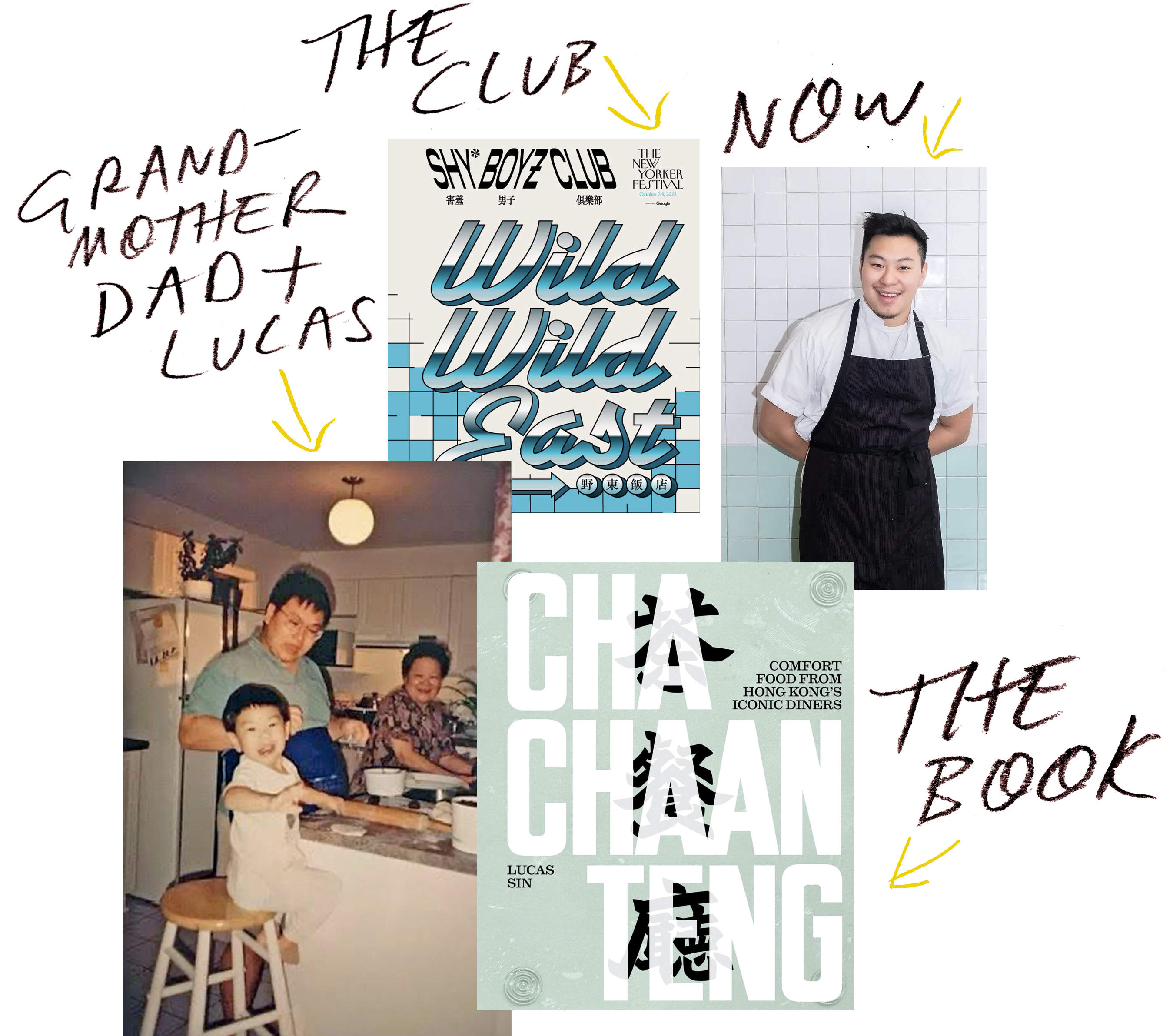
Take it away, Lucas…
My grandmother was a cook, albeit a reluctant one. She started young, not long after she got to Hong Kong, and cooked in mahjong parlors for most of my life.
One of the first things she taught my father, who later taught me, was this steamed meatloaf.
Meatloaf is a home-style dish in Hong Kong, and its comfort—its buoyancy, its smoothness—comes down to technique. The dictum everyone follows is that you mix the pork vigorously, only in one direction. Turns out there’s a real reason for that: working minced pork in one direction extends the protein strands and pulls the myosin out of the meat, which wraps around the water and keeps it from drying out. Home cooks do this. Restaurant kitchens do it too.
In cha chaan teng, this kind of steamed pork usually gets something aggressive on top: salted squid, salted fish. My grandmother’s version uses salted egg yolk instead. It gives the dish a pungency, a lift, that I still find nostalgic every time I make it.
What gets me about this recipe is that it proves something I already believed, which is that family recipes and food science aren’t actually in conflict. And in writing this book, it’s a joy to understand that grandmother’s technique holds up under the lens of modern culinary science.
Though I don’t buy the idea that food tastes better because it was made with love. But I do think this recipe is proof that food gets better when it’s made with attention and care, and the kind of intentionality my grandmother cooked with. She gave that to my father. He gave it to me.
STEAMED MEAT LOAVES WITH SALTED EGG YOLK/ 鹹 蛋 肉 餅 鹹 蛋 肉 餅
This is not the meatloaf Americans know. It doesn’t slice; it scoops. The
Texture is smooth, yielding, and pleasantly elastic. The salted egg yolk
On top, the lb melts in as it cooks, running salt and richness through the meat.
SERVES 2 OR 3
For the Meat Loaves
1 pound (450 g) boneless, skinless pork shoulder, chilled in the freezer for 15 minutes
2 tablespoons (30 ml) light soy sauce
1 (½-inch/1.25 cm) knob fresh ginger (12 g), peeled and minced
1 tablespoon (15 ml) oyster sauce
1 tablespoon (15 ml) Shaoxing wine
1 tablespoon (8 g) cornstarch
1 teaspoon (5 ml) toasted sesame oil
1 large egg white (40 g)
1 teaspoon (4 g) sugar
¼ teaspoon (2 g) table salt
2 salted duck egg yolks
(see Notes)
TO SERVE
1 scallion (15 g), thinly sliced
2 cups (450 g) cooked white rice (page 000), warmed
Prepare the meat loaves. Dice the pork shoulder into ¼-inch (6 mm) pieces. Set aside a third of the diced pork. Finely chop the remaining pork, pushing and rotating the mixture until the pork is as fine as store-bought ground pork. Transfer to a medium bowl.
Add the soy sauce, ginger, oyster sauce, Shaoxing wine, cornstarch, sesame oil, egg white, sugar, and salt to the minced pork. Using your hands, vigorously stir the seasoning into the mix. Continue mixing in one direction, squeezing occasionally, until you notice white strands of protein that look like fine tendons. Once these strands reach about 2 inches (5 cm) in length, begin slapping the meat mixture by balling up the mixture into one mass and throwing it back into the bowl. Repeat until the mixture holds together as one, feels bouncy, and springs back when pressed. Mix the reserved diced pork into the slapped mixture for texture.
Let the mixture sit in the fridge for at least 15 minutes or up to overnight.
KITCHEN NOTES
Hand-chopping the pork creates different-sized pieces for a more interesting texture. Store-bought ground pork will cook well but yield a more uniform, cohesive texture. Mixing the pork vigorously helps release myosin from the meat, resulting in a loaf that is deeply seasoned, springy, and juicy. Repeatedly slapping the mixture incorporates air within the extended strands of protein, giving the meatloaf its characteristic bounce. Salted duck egg yolks on top of steamed meats are a classic Cantonese touch. Crumbly, rich, and briny, they break the uniformity of flavor and give contrast to each mouthful. In Hong Kong, salted Eggs are sold raw, and the yolks are separated. From these, whole duck eggs are best. Individually sold salted duck egg yolks are drier in texture because they’re salted. Individually, they work fine here. Divide the meat mixture into two. On a steam-proof plate, shape each half into a 1½-inch-thick (4 cm) disc. Place one egg yolk on top of each meatloaf.
VARIATIONS
Popular mix-ins for Cantonese meatloaf include shiitake mushrooms 冬菇, salted fish 鹹魚, pickled Chinese mustard 梅菜, water chestnuts 馬蹄, and dried squid 土魷.
Set a steamer basket over a pot or wok filled with 2 inches (5 cm) of water and bring the water to a boil over high heat. Add one meatloaf on its plate to the steamer and cover. Steam for about 12 minutes, until the center registers 165°F (74°C). Remove from the steamer. Drain and discard any liquid that may have accumulated on the plate. Repeat to steam the other meatloaf. Garnish the meat loaves with the scallions and serve warm, with a bow.