


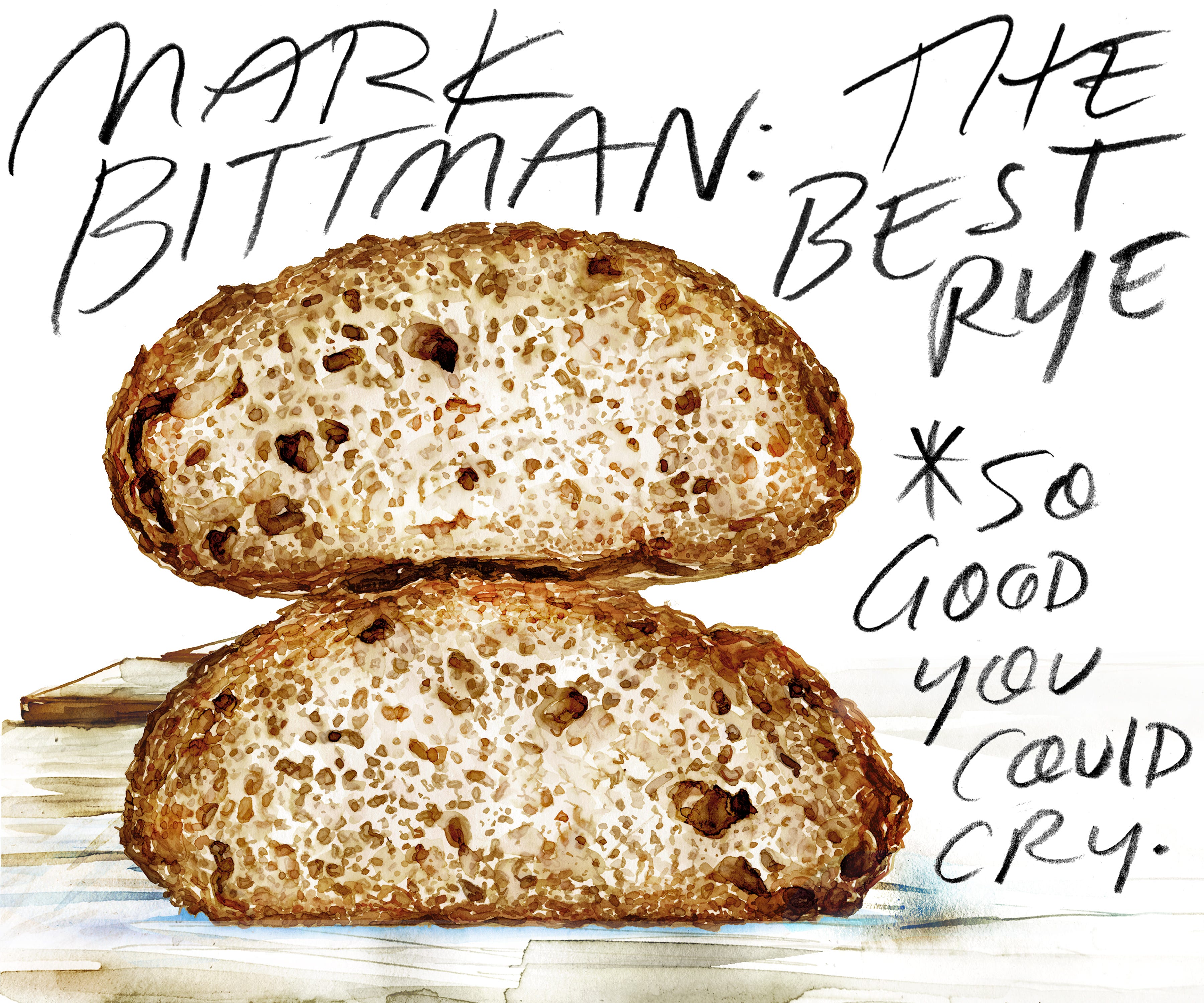
Hi friends. Welcome to the table. My next guest is Mark Bittman. I’ll keep the introduction succinct, which requires a lot of restraint, or it’d be Russian-novel length. Mark wrote How to Cook Everything, that trusty tome on top of your fridge (published in 1998; millions of copies sold). He’s won six James Beard Awards and written over 30 books. He’s also an activist and advocate for public health, sustainable agriculture, and plant-based eating. Mark and his daughter, Kate, started The Bittman Project for cooks and food lovers (the Substack is here). They also founded Bittman’s, a maker of premium, whole-grain sourdough, delivered frozen and ready to bake at home.
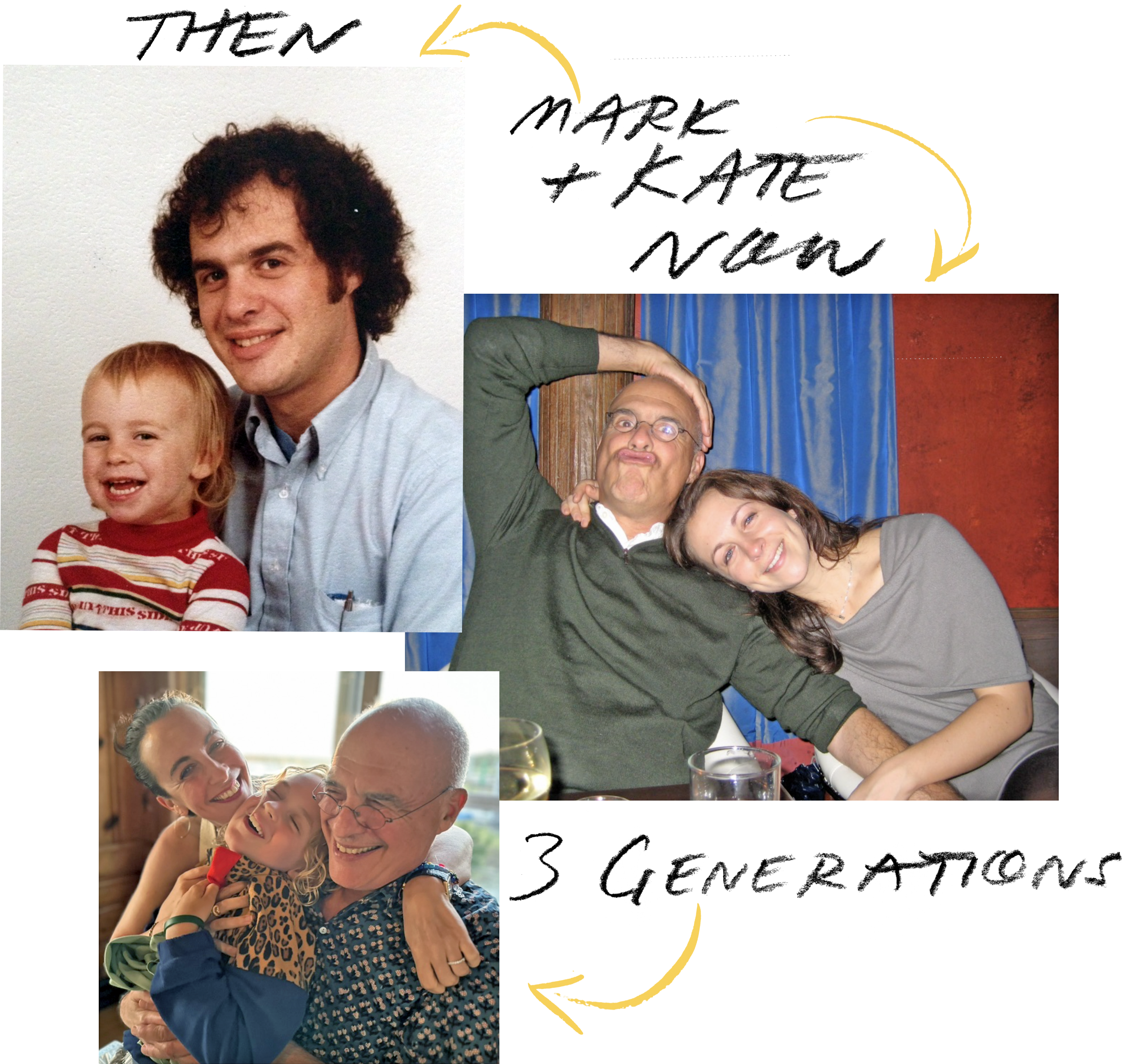
When I wrote to Mark asking for a recipe with personal significance, he sent his signature loaf from Bittman Bread: No-Knead Whole Grain Baking for Every Day: “We can talk about rye bread for as long as you like,” he wrote. “It’ll be fun.” I had the pleasure of chatting with him about both of his grandmothers’ cooking, Craig’s Bakery, where his love of rye began when he was a kid, and how he stumbled into becoming one of the most renowned voices in the food space. Before you read the interview, take a peek at three Bittman generations.
Was there a spark moment when you knew cooking was your thing?
There really wasn’t a moment. My intention was for writing to be my thing. Cooking was kind of a hobby. We’re going back 50-plus years. I was obsessed with cooking. I really loved it, but it never occurred to me that it would be a career. I was trying to be a writer. I guess if there was a spark moment, it was that the first paid, published article I wrote was about food. So then it was like, people like it when I write about food, so I’ll write about food. That was in 1980, after four or five years of trying to write and being unsuccessful, and after about ten years of teaching myself how to cook.
What made you want to make cooking accessible to other people in your writing?
I’m not a trained chef, so I had no choice. That was how I cooked. I cooked simply. It would have been ridiculous for me to try to write any other way.
Your mom used to send you to Craig’s Bakery on First Avenue for rye bread, and you’d eat a quarter of the loaf on the way home. What do you remember about Craig’s, and what made the bread so special?
She sent me to buy bread two or three times a week. On Sunday mornings I would usually go out for bagels and bialys and that kind of stuff with my father. But it was the rye bread I always remembered. You could get it with seeds or without, and that was my choice. I would alternate between them. It was fresh-baked and it was so great. It was the only bread we ever had growing up with a real crust. It was probably the closest thing to a traditional, old-world bread that we got. There’s challah, but that’s brioche, it’s cake. It’s not really bread in the same sense that rye bread is bread. So I just always loved it.
Here’s the other thing: it’s not easy to make. I tried for years and years to make rye bread and onion rye bread, which we would have occasionally, and it just wasn’t that good. Then I started making bread with sourdough, and I discovered the secret to good rye, which is also the secret to good whole-grain bread: you have to use a natural starter. Now I can make good rye bread. So that’s great, because Craig’s isn’t there anymore.
When you taste your rye, does it make you nostalgic for Craig’s? Or does it feel more like your own take?
Mine has more rye in it than Craig’s did, and whole wheat, which Craig’s never had. So it’s actually a better bread. But for nostalgia purposes, if someone gave me a loaf of Craig’s rye bread, I’d cry. My bread doesn’t quite make me cry.
When someone bakes your rye bread for the first time, what do you hope their experience is, and how do you hope they feel when they pull it out of the oven?
I hope making it is easy and satisfying, which our bread should be. It’s really hard to buy rye bread that good. We went to the opening party for a very trendy new bakery and restaurant in SoHo, run by an Austrian family that’s been making rye bread for a hundred years. I went fully prepared to be blown away, to think, “Oh my God, these people’s rye bread is so amazing, we have to work on ours.” Ours is just as good. I’m obviously very happy about that. I think our rye recipe, the same one we use at Bittman’s, our bread company, is as good as it gets. It’s really terrific.
Recipes shared on Art Basil are often tied to family, e.g, cooking beside a grandparent or parent. Was that true for you?
You know, quite honestly, my mother was not a great cook, and I did not cook by her side very much. So there’s none of that romance of mom’s cooking and all of that bullshit. That’s just not me. Both my grandmothers were amazing cooks of Eastern European Jewish food, but they weren’t inviting people. One was pretty much an illiterate, unassimilated immigrant who didn’t leave the house much. She was a great cook, but she just wasn’t an outgoing person at all. The other, who was more outgoing and fun, took everything for granted. If you tried to ask her questions (and you hear this from millions of people who talk about cooking with their grandmothers), she’d always say, “What do you mean, how much? What do you mean, how long do you cook it? You cook it till it’s done. What do you mean, how much flour? You add flour until it looks like this.” She wasn’t interested in sharing what she knew.
My grandmother’s food was great, but very, very limited. It was five or maybe ten fantastic things. She learned how to make spaghetti and meatballs from an Italian neighbor, and they were the worst spaghetti and meatballs you’ve ever had. She cooked what her mother had taught her, and she never really added much to that. I know a lot of people like this, who can cook the food of their culture and never learned to cook anything else, and of course that’s fine. When I was young, I was interested in cooking the kind of food my grandmother made, but I was equally interested in learning to cook Indian food and Japanese food, and of course French and Italian food. At the beginning, I was more interested in Asian cooking. I don’t know where that came from, but that’s the story.
It makes sense that your curiosity, because no one taught you, compelled you to dig in on your own to find the mysteries and secrets of cooking, and then share them with others.
You work with your daughter, Kate. Do you cook together? What kind of cook is she, having grown up at your table?
She follows recipes. Sometimes she uses mine and sometimes other people’s. We have different styles. I really respect her palate. She grew up in a house with way better food than the house I grew up in. She’s been eating good food since she was born, and that could not be said of me.
Does Kate’s son/your grandson show any interest in cooking?
He kind of pretends to. He’ll get there.
Asking for myself: how do I get my kids to want to work with me when they grow up?
Kate has really worked her way into a place where she’s indispensable, and we’re really partners. She’ll clearly take over at some point. I don’t know how to make it happen. I just know it’s a really nice thing. I like it, and so does she.
Anything else you’d like to share about the rye bread?
When we were figuring out the core offerings of Bittman’s Bread, I insisted that the rye be one of them. It still is, and I think it will stay that way because it’s really good and people like it.
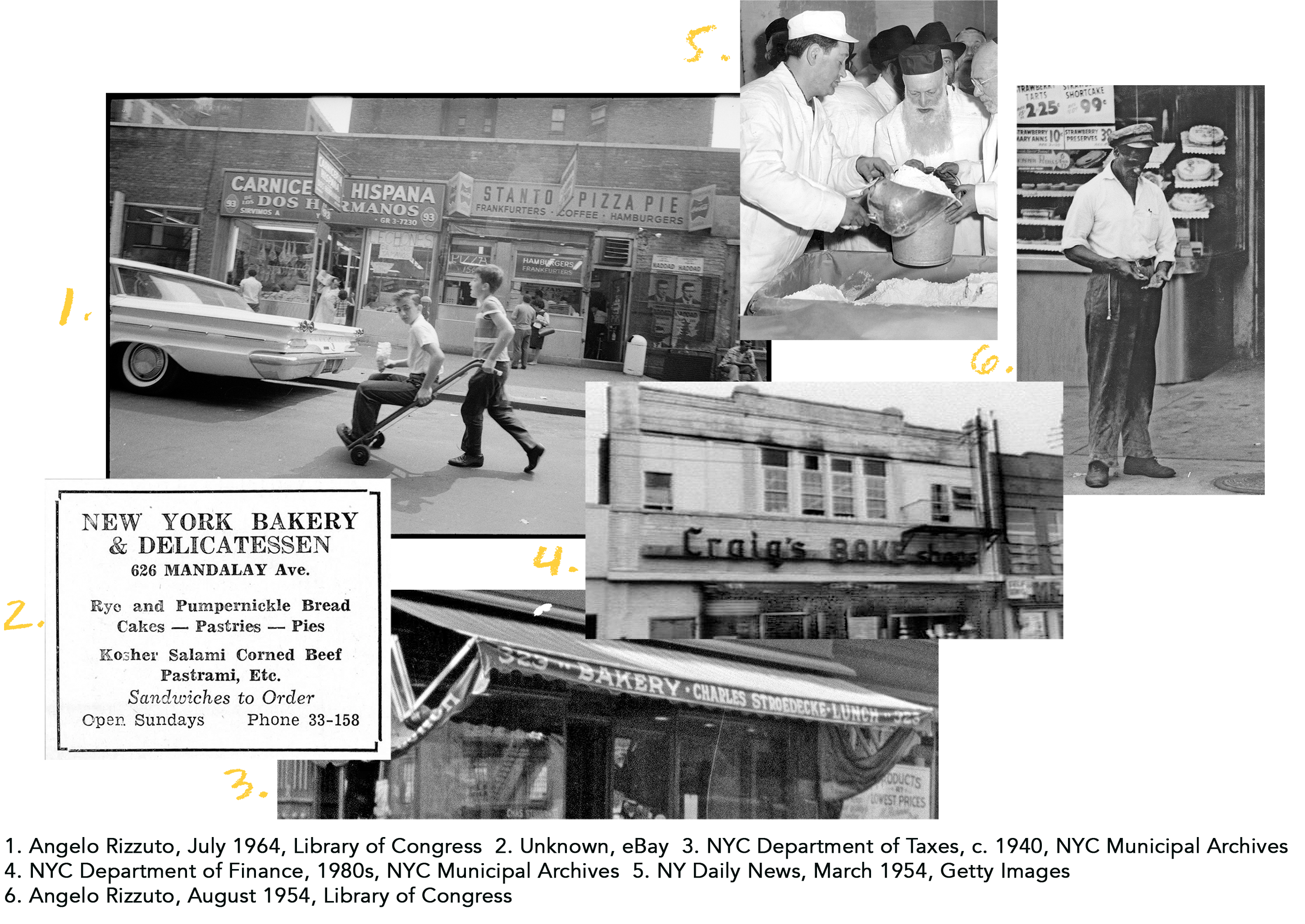
Alas, I couldn’t find a photo of THE Craig’s Bakery on First Avenue. But I dug around and found some great snaps of NYC from when Craig’s was a neighborhood fixture, and Mark was bopping around the bakeries of the day.
Mark’s Rye Bread Recipe
(From Bittman Bread by Mark Bittman and Kerri Conan.)
Mark’s whole grain rye has a crackly crust and a light, slightly chewy crumb. The caraway seeds are optional, but he uses a lot.
Bonus! Mark’s daughter, Kate, has generously removed the paywall so you can grab their fastest and easiest Bittman starter. Pick up the book for lots of bread recipes using Mark’s no-knead method. I’m pasting it below the recipe too.
Makes
1 loaf (12 to 14 ½-inch slices)
Time
8 to 12 hours for the jumpstarter
About 3 hours of intermittent activity to mix and fold the dough
About 90 minutes of intermittent activity to shape, rest, and bake the loaf
Ingredients
100 grams whole wheat starter
270 grams whole wheat flour, plus 50 grams for feeding the starter
210 grams water, plus 50 grams for feeding the starter and more as needed for folding
30 grams whole grain rye flour, plus more for dusting the top (optional)
7 grams salt, or to taste
25 grams caraway seeds, plus more for the top (optional)
Coarse salt for topping (optional)
Combine the starter, 100 grams of the whole wheat flour, and 100 grams of the water in a large bowl to make the jumpstarter. Stir, scraping the sides and bottom as necessary, until all the flour is absorbed. Cover with plastic or a damp kitchen towel and let it sit at room temperature for 8 to 12 hours. The jumpstarter will bubble and become quite fragrant. (The timing is flexible to fit your schedule.) Meanwhile, feed the remaining starter: Add 50 grams each whole wheat flour and water and stir or shake. Cover and return the starter to the refrigerator.
When you’re ready to make the dough, add the remaining 170 grams whole wheat flour, the 30 grams rye flour, and 110 grams water to the jumpstarter. Stir with a rubber spatula or your wet hands until a dough forms and looks springy, 1 to 2 minutes. If flour still clings to the bottom or edges of the bowl, stir in more water a dribble at a time as you work. The dough should be wet and shaggy but will form a loose ball. Cover and let it sit for about 1 hour.
With wet hands, fold in the salt and caraway seeds, if you’re using them, adding just enough water to prevent stickiness. Cover again and let sit for about 30 minutes.
Proceed with the four folds as described below, at 30-minute (or so) intervals. As you work, wet your hands and, if necessary, your work surface with just enough water to keep the dough from sticking. This dough won’t absorb water the same way as the basic loaf, so be prudent; you don’t want the dough to become shaggy and loose. At some point during the folds, line a 2-quart ovenproof pot with a lid with a sheet of parchment paper, pressing it into the bottom and creasing it over the lip to keep it in place.
After the fourth fold, wet your hands one final time. Lift the dough ball, cupping your fingers under the bottom, and lower it into the center of the parchment paper–lined pot. Cover the pot with plastic or a damp kitchen towel and let it sit until the dough puffs a bit and an indent made with your finger springs back slowly, 15 to 30 minutes.
Dust the top of the dough with rye flour and/or a sprinkling of caraway seeds if you like and slash it with a couple of parallel lines. (Mark sometimes sprinkles coarse salt on top too.) Cover the pot with its lid, put it in a cold oven, and set the heat to 485°F. After 30 minutes, carefully remove the lid. Return the pot to the oven.
After another 15 minutes, turn the heat down to 400°F. Remove the pot from the oven, carefully take the loaf off the parchment, and place it directly on the rack (or on a pizza stone, if you keep one in your oven). Bake for about 30 minutes, until the crust is dark and an instant-read thermometer inserted into the center registers about 205°F. Transfer the bread to a wire rack. Cool completely before slicing.
Folding the Dough, Mark’s Way
Mark starts by wetting his work surface and hands before transferring the dough from the bowl. Use outstretched fingers to flatten it by pressing purposefully but not too aggressively. You’ll notice a slight milkiness to the water on the surface; that signals the dough doesn’t need any more water than what it takes to keep your hands from sticking.
Mark begins each of the four folds with an oval-ish shape, about ½ inch thick. It doesn’t matter if the shape is irregular.
Then he lightly stretches and folds the dough over itself in thirds: first from one long edge, then from the other, so it looks like you folded a letter.
Working from the short ends, next Mark folds the dough in thirds again from the other direction.
And you’re left with a multi-layered square. Again, press gently with flat fingers to help the dough come back together.
Mark finishes the fold by gathering the edges and corners of the square underneath the dough, tucking and rolling with his fingers and palms to seal a seam at the bottom and shape a ball.
The dough will tell you when it can’t absorb any more water: watch for the slightly milky liquid to start forming; it will coat the bowl or cutting board, and a little may sit on top of or around the edges of the dough. That’s when to stop. Using more than enough to prevent sticking from this point on may make the dough shaggy again and fall apart; you don’t want that.
A half-hour between folds is really a suggestion. You can rush a bit and cut it to 15 or 20 minutes. (Even 25 minutes, over four folds, gives you a little extra free time.) Or you might get distracted and let it go 45 minutes. Once you can read the dough, you can make adjustments on the fly.
Dough Texture After Each Fold
After the first fold: At the beginning, the dough is rough and shaggy and not yet elastic enough to stretch much. You might need to incorporate some water at this stage—enough on your hands to create a sheen on the surface without causing a milky residue that doesn’t fully absorb.
After the second fold: The dough will be less rough and shaggy, and will start to puff up and become stretchy. You might even start to see some air bubbles. It might still absorb some water at this stage, but be careful not to over-wet it.
After the third fold: When you shape it into a ball, it holds together better and is much smoother on the surface. Notice there’s some sheen, but not much milky residue on the work surface. And there should be more bubbles.
After the fourth fold: When you folded this time, did the dough look so lively it seemed to be breathing as you handled it? The surface will be smooth, and bubbles should be visible. Now it’s ready for the pot.
Super Rye
This will be slightly denser, with a tad less doming, especially if the flour you’re using doesn’t develop good elasticity or strength. But it’s so rye-y that true enthusiasts like Mark’s friend and neighbor Danny—an unofficial tester over the years—will be happy to make the trade-off. In Step 2, increase the rye to 50 grams and reduce the whole wheat to 150 grams. Be extra careful not to oversaturate the dough with water during the folds. Everything else remains the same.
Onion Rye
Use the main recipe. When you add the salt in Step 3, fold in 50 grams chopped onions (½ medium or one small) and reduce the caraway to 20 grams if using.
The Bittman Starter Recipe
(From The Bittman Project.)
In a bowl (or a plastic-covered container), combine 1/4 teaspoon instant yeast with 1/2 cup of flour (whole wheat is best, but all-purpose is fine here) and enough water to produce a thick batter – 3/4 cup or so. Stir that, cover it with plastic or the lid, and leave it at room temperature for 12 to 24 hours.
You can feed this once or twice a day; either will work, but twice a day will give you faster results. Just add another 1/2 cup of flour and enough water to restore the texture to batter-like. The mixture will be bubbly and smell yeasty. (If it gets too big for your container, you can discard some or make pancakes – but that’s not a requirement.) After three or four feedings – probably by the second day and certainly by the third (counting the first day as zero) – this starter will power any sourdough bread recipe, and you’ll never need yeast again. (Or you can wait up to 72 hours before using it; just cover and refrigerate it until you need it. You can wait even longer if you keep feeding it.)
Every time you bake, or once a week if you’re not baking anything, feed the starter roughly equal weights of flour and water to compensate for whatever you use. (Occasionally you may add a little more water to keep the starter loose enough to easily spoon or pour.)
I could cry — I love this so much. Thank you, Samantha. 🥹