


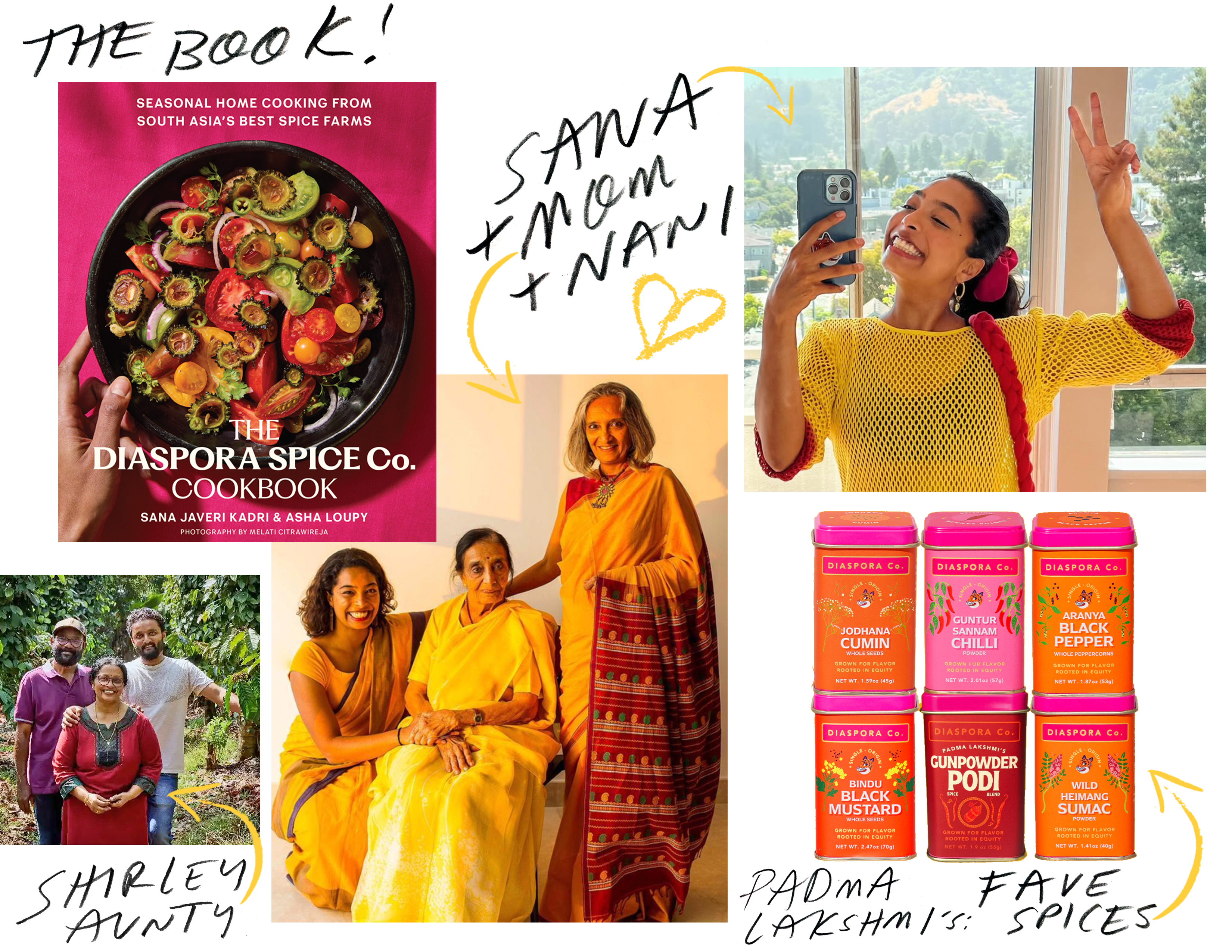
Sana Javeri Kadri, California-based (by way of Mumbai, India), self-describes as “eldest daughter, proud immigrant and incorrigible queer menace.” She takes photos, writes, and is the founder of Diaspora Spice Co. (which sells regeneratively farmed, single-origin spices sourced directly from South Asia). Her book, The Diaspora Spice Co. Cookbook: Seasonal Home Cooking from South Asia’s Best Spice Farms, serves as a guide to cooking with spices and incorporating South Asian techniques and flavors into your home cooking. Co-authors Asha, Melati, and Sana travelled across Diaspora Spice Co. farms in India and Sri Lanka to gather 100+ heirloom family recipes. Subscribe to her Substack: Start Here.
Read my interview with Sana about the significance of the intergenerational and intercultural recipe she’s sharing with us, but first look at her!
Hi Sana, please share why this Jammy Egg Curry recipe is meaningful to you.
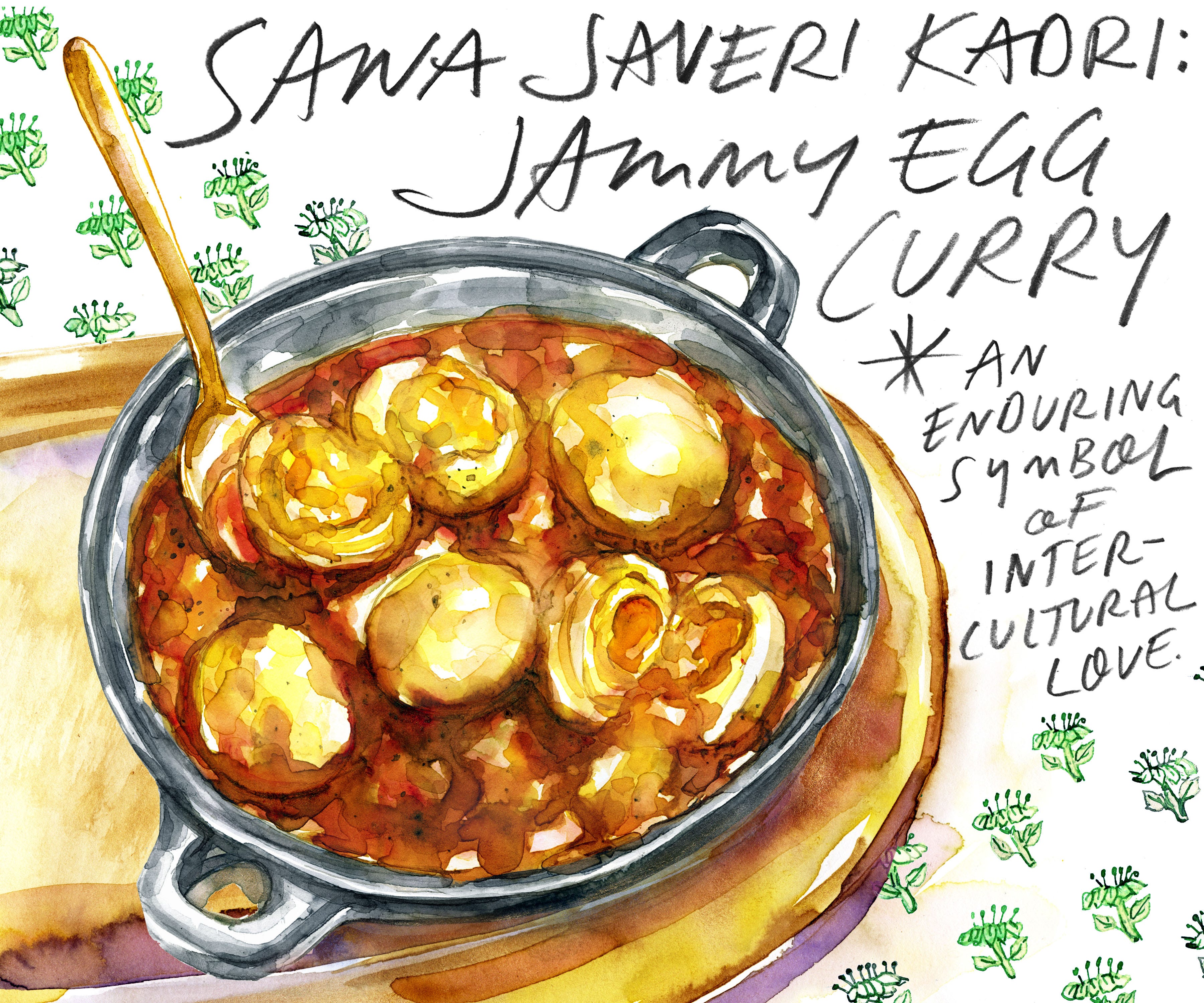
In my family, egg curry was a symbol of love. As a Jain, my Nani grew up strictly vegetarian, not even eating eggs or root vegetables. My father (her son-in- law) was among her favorite people in the world, and she was always worried that eating at her home was unsatisfactory for him as a non-vegetarian. Her upbringing and values didn’t allow her to cook meat in her own home, but her compromise was that she would make him an egg curry. For a practicing Jain to bring and cook eggs in their home simply out of good hospitality and love is culturally a way bigger deal than I feel like I can articulate. So, my entire family has come to cherish egg curry as an enduring symbol of my parents’ intercultural love match and my nani’s deep adoration for her son-in-law.
You describe your parents as having an “intercultural love match.” What is your dad’s culture? Did your extended family immediately welcome him?
My mom is Gujarati Jain and comes from a pretty classic, purely vegetarian, slightly conservative-leaning Gujarati Jain family. What was non-traditional is that my grandmother — my mom’s mom — worked and was a pretty pioneering gynecologist who persevered to get her education despite a lot of opposition.
On my dad’s side, he is also the product of an intercultural love match. My dad is half Hindu, half Muslim. His mom is Punjabi Hindu, and his dad is Gujarati Muslim. That was a marriage that was very fought against by their families, and being a Hindu-Muslim mix in the ‘60s, ‘70s, ‘80s, ‘90s, and 2000s — so basically his entire life — was always very complicated. But I think the beautiful thing about my dad’s parents’ home is that both religions were celebrated and both cultures were honored.
So when my parents met, it was suddenly, again, a Hindu-Muslim mix, and a lot of different cultures coming together. I think my mom’s family loved my dad, and still do. He was warm, he was kind, he came from a good family, and he was tall and handsome. So yes, I think my dad really was welcomed into my mom’s family despite being quite different from them.
I’d love to hear about the special bond between your dad and Nani.
My Nani had three daughters, of which my mom was the youngest. Her older two daughters moved abroad, and my mom stayed in Mumbai and chose to live about a five-minute drive away from her mom. Despite my grandmother — my Nani — being closer initially to her older two daughters, because my mom was the rebel, the very rebellious youngest daughter, over time, because of proximity and just seeing each other so much, they became very close.
But I think the most special relationship was that my dad, who is this sweet, loving, funny man, came to have a very beautiful, tender relationship with my Nani — she just adored the ground he walked on. I think the only person she loved more than my dad was my brother, a.k.a. my dad’s son, because he was the next generation of my dad, recreated. In terms of why she loved him, it wasn’t so much about his class, his status, his job, or his accomplishments. I think he was just very kind and sweet and loving and funny, and he made an effort to have a casual relationship with her, which meant a lot. When you have a person like that show up in your life twice a week for almost 40 years, you get very close.
That’s where that egg curry recipe comes from. It was my Nani’s way of making sure that her son-in-law had something he liked to eat at the table. Later in her life, she even went so far as to say that if you wanted to bring meat dishes from outside, heat them up at her house, and eat them, she would be okay with that. It’s hard to explain just how wild that is — that a Jain woman raised in a strict Jain household, who ran a very strict vegetarian household, would allow meat to come into her home and be heated up so that her son-in-law, and then his kids, her grandchildren, would feel welcome.
What I find very progressive and radical about my Nani was that her idea of hospitality was both sharing her favorite dishes and her favorite drinks and organizing these epic Gujarati feasts, but also understanding that hospitality meant catering to other people’s needs. In this case, that involved bringing egg and meat or seafood into her home, even if she wasn’t comfortable eating it or being around it. It was pretty amazing that she allowed that. We started having fried fish and mutton curry and those kinds of things at my Nani’s home, as long as it was just on the other side of the table from her. She really encouraged it, actually, which is so special. It was definitely not the kind of militant, morally superior vegetarianism that you see today. I think my Nani was more progressive in her vegetarianism and her inclusivity than a lot of people are today.
The recipe sounds so special and delicious. You mention that it’s fast and a go-to weeknight meal. Seems like a perfect, flavorful, and high-protein meal. Did Nani serve it alone or with a veggie side dish? If so, what did she love to pair it with?
The typical Gujarati table, in our household anyway, was always two vegetable dishes, a dal, roti, and rice. So there were always two vegetarian dishes. Because I loved bhindi, or okra, more than life itself, there was usually bhindi. Another dish they made for us often was a cauliflower and peas dish. We called it phoolvar ani batata, which means cauliflower and peas. Then there would be some kind of light dal. So the egg curry was on the table, but it was part of that complete plate of two veggies, a dal, some roti, and some rice.
Shirley Aunty, the matriarch of the Aranya Pepper farm, makes an egg curry that is on a whole other level. The browned shallots and spices cooked in coconut milk become so silky and rich it’s hard to believe how simple the ingredients list is.
Anything you’d like to share about developing this recipe for your book?
My one request to Asha when we were developing this recipe was that the eggs be jammy and yet as saturated with the curry and as much flavor as possible. Scoring the sides of a seven-minute egg so that you’re effectively braising it in the curry is a game-changer. This recipe has joined my personal weeknight dinner hall of fame because it’s so quick and comes together with pantry staples.
Jammy Egg Curry Recipe
TOTAL TIME: 45 minutes
4–6 servings
Ingredients
8 large eggs
3 Tbsp. Virgin coconut oil
2 tsp. coriander seeds, lightly crushed
4 large shallots (about ⅔ lb./300 g), finely diced
1½ tsp. fine sea salt, plus more if needed
1 Tbsp. Byadgi chilli powder
1 tsp. ground turmeric
¼ tsp. freshly ground black pepper
1 14-oz. (398-ml) can full-fat coconut milk
Juice of 1⁄2 lemon (1–2 Tbsp.), plus more if needed
Preparation
Step 1
Bring a large pot of water to a boil over high heat. Gently add 8 large eggs and boil for 7 minutes, then, using a slotted spoon, transfer them to an ice bath to cool while you make the sauce.
Step 2
To prepare the sauce, heat 3 Tbsp. Virgin coconut oil in a large skillet over medium heat. Add 2 tsp. coriander seeds, lightly crushed, and cook, stirring frequently, until they turn light golden, 30–45 seconds. Add 4 large shallots (about ⅔ lb./300 g), finely diced, and 1⁄2 tsp. fine sea salt to the skillet and cook, stirring occasionally, until the shallots soften and turn light golden, 7–11 minutes. Stir in 1 Tbsp. Byadgi chilli powder, 1 tsp. ground turmeric, ¼ tsp. freshly ground black pepper, and 1⁄2 cup (120 ml) water, and cook until the water evaporates, 4 to 7 minutes.
Step 3
Stir in one 14-oz. (398-ml) can full-fat coconut milk and the remaining 1 tsp. fine sea salt. Reduce the heat to medium-low, partially cover, and simmer until the sauce is reduced by a quarter and the oil is starting to separate, 9 to 12 minutes.
Step 4
Meanwhile, peel the eggs and score the whites of the eggs lengthwise about 5 times around each egg, being careful not to cut too deeply and hit the yolk. (This will help the sauce permeate the egg.)
Step 5
Gently add the scored eggs to the skillet and continue to cook, gently basting and turning the eggs over in the curry until the outsides of the eggs start to take on the color of the sauce and are heated through, 4–6 minutes.
Step 6
To finish, stir in juice of 1⁄2 lemon (1–2 Tbsp.). Taste and season with more salt and/or lemon juice, if necessary.